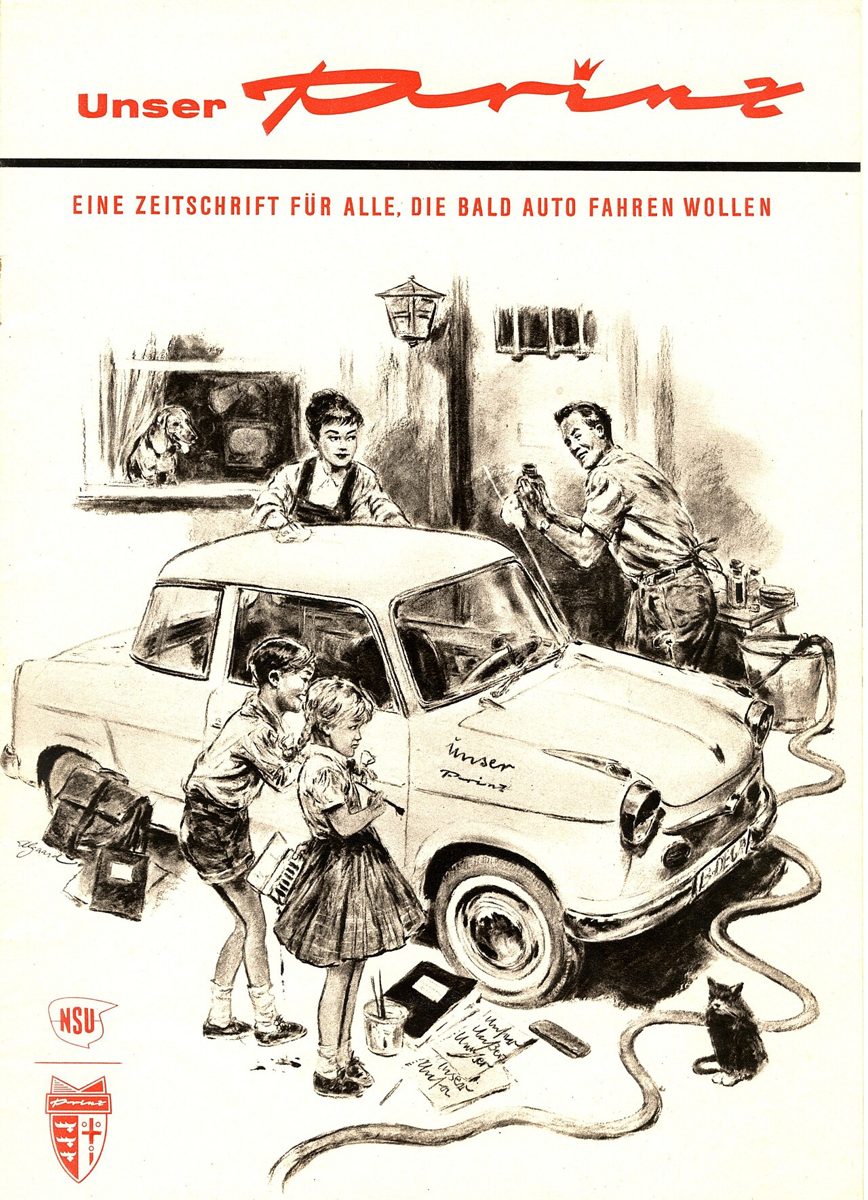
There is a particular sound that belongs to an NSU Prinz: not the flat, hollow drone of a Volkswagen, but a harder, busier, almost motorcycle-like chatter from a small air-cooled twin tucked away behind the rear axle. It is a sound that once echoed through the streets of Neckarsulm by the tens of thousands, and today it is heard mostly at classic-car gatherings, hillclimbs and the occasional Sunday morning blast along a river road. If you have found your way to this corner of the forum, you already know why that matters. This is the story of NSU's air-cooled era — the machines, the engineering, the racing, and the reason a small German factory briefly became one of the most interesting carmakers in Europe.
A Bicycle Town That Learned to Build Engines
NSU's roots are far older than any car it ever made. The company traces back to the 1870s, when Christian Schmidt and Heinrich Stoll set up a knitting-machine works in Riedlingen that later moved to Neckarsulm, a small town on the Neckar river in Württemberg. Bicycles followed in the 1880s, motorcycles in 1901, and by the 1930s NSU was one of the largest motorcycle manufacturers in the world, with a factory complex that dominated the town. Cars had come and gone — the little NSU 6/60 of the 1920s, the rear-engined NSU-Fiat era — but it was the two-wheelers that paid the bills.
The Second World War flattened much of that. Neckarsulm was bombed, the works were damaged, and the company restarted in the late 1940s building bicycles, small motorcycles and the odd three-wheeler. What saved NSU was a simple insight: post-war Germany needed cheap, simple personal transport, and it needed it fast. The answer was the Quickly, a 49 cc two-stroke moped launched in 1953 that became a national phenomenon. Light, cheap, easy to ride on a car licence, the Quickly sold in the hundreds of thousands and gave NSU both cash and confidence. It also gave the company a generation of engineers who understood small, air-cooled two-strokes better than almost anyone in Europe.
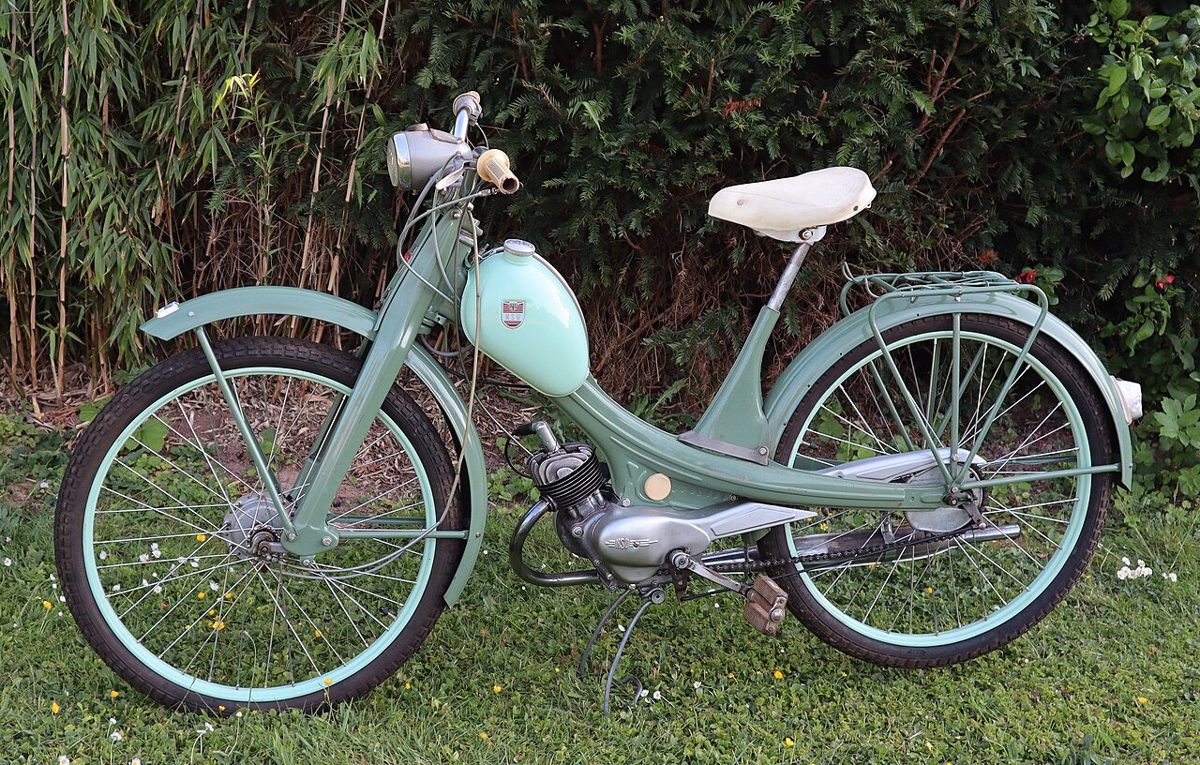
The Quickly is worth a moment for anyone who thinks of NSU only as a carmaker. Its pressed-steel frame and single-cylinder two-stroke were pragmatic engineering at its best, and its success funded the programme that produced the Prinz. Many of us came to the Prinz through a parent's Quickly; the family resemblance in philosophy is not a coincidence.
1957: The Prinz Arrives
By the mid-1950s NSU's management could see the writing on the wall. The moped boom would not last forever, and the real growth was in small cars. Volkswagen had proved the rear-engined, air-cooled formula with the Beetle, and every German manufacturer worth its salt was looking at a "people's car" of its own. NSU's answer, unveiled at the 1957 Frankfurt Motor Show, was the Prinz — a compact two-door saloon with a 583 cc air-cooled parallel twin mounted longitudinally behind the rear axle.
The layout was unusual even by rear-engine standards. The engine sat ahead of the gearbox, with the cylinder block lying almost flat and cooled by a belt-driven fan; the gearbox fed a swing-axle rear end. Power was modest — around 20 hp in the first cars — but the Prinz weighed barely 500 kg, so performance was entirely respectable for the class. The body was a clean, slightly bulbous three-box shape with a hint of American influence in its wraparound rear window, and it was roomy enough for four adults in a way that the microcars of the period were not.
The early Prinz established the template that would define NSU for the next fifteen years: a small air-cooled engine in the tail, a light steel body, and a chassis tuned for agility rather than comfort. It was not fast, but it was tough, economical and — crucially for a nation rebuilding its roads and its confidence — fun. NSU sold over 150,000 Prinz I and II models before the end of 1961, and the car quickly became a fixture of German streets alongside the Beetle and the Lloyd.
The Prinz 4: The Shape Everyone Remembers
For most enthusiasts, "NSU Prinz" means the Prinz 4 of 1961. The new car kept the mechanical package — air-cooled rear twin, now 598 cc and around 30 hp — but wrapped it in a body that looked like nothing else on the road: a crisp, boxy three-box saloon with a flat front panel, a simple grille, and a rear end that sloped away in a way that made the car look faster than it was. The styling was the work of NSU's own team under Claus Luthe, who would later become one of the most influential designers in the industry at BMW.
The Prinz 4 was a huge success: cheap to buy, cheap to run, and surprisingly capable. NSU built more than 600,000 of them, and the car stayed in production until 1973 — long after NSU itself had ceased to exist as an independent company. In Britain its layout was licensed to Rootes for the Hillman Imp.
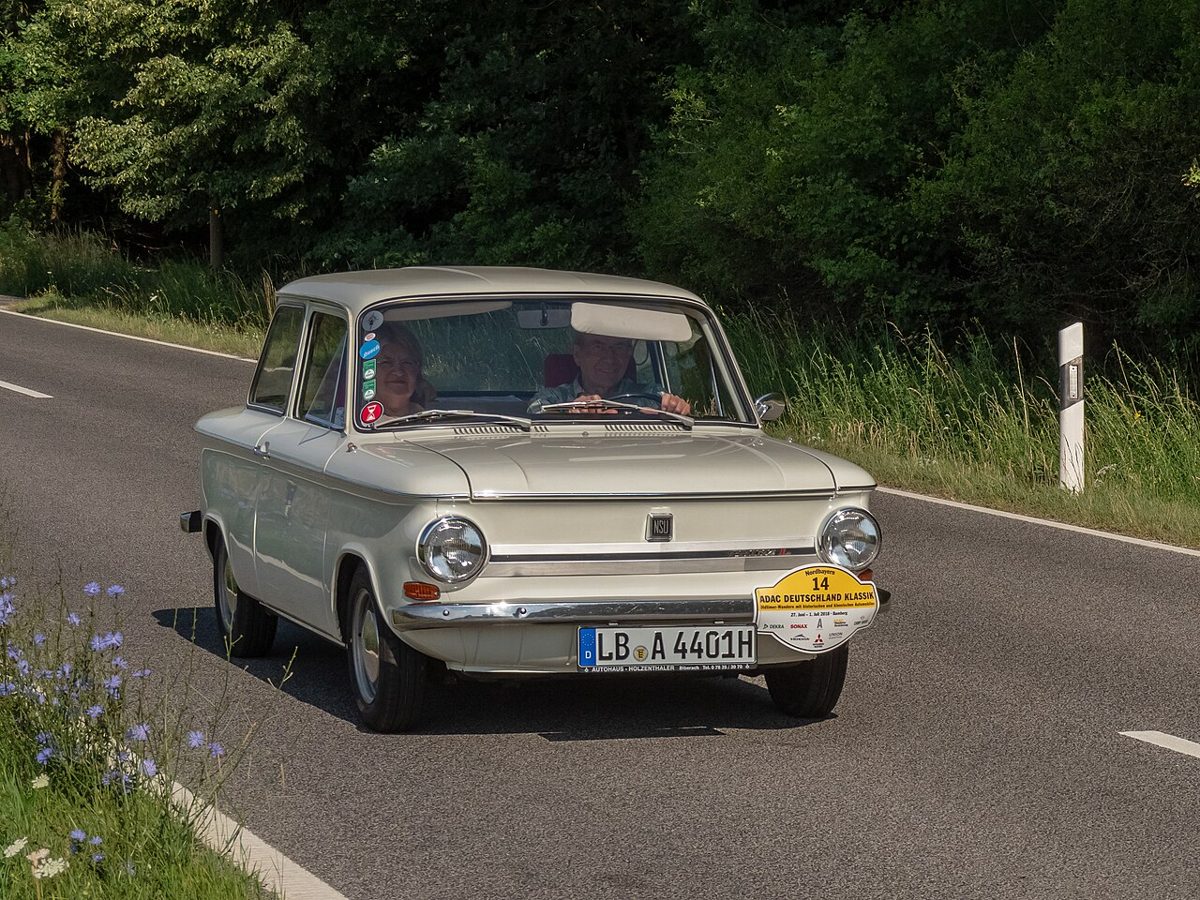
The Prinz 4 L added a little more equipment and a slightly more powerful engine, and it is the version most often seen at shows today. Look closely and you notice how much thought went into a very small package: the spare wheel up front, the fuel tank behind the rear seat, the simple, honest dashboard.
Under the Lid: The Air-Cooled Heart
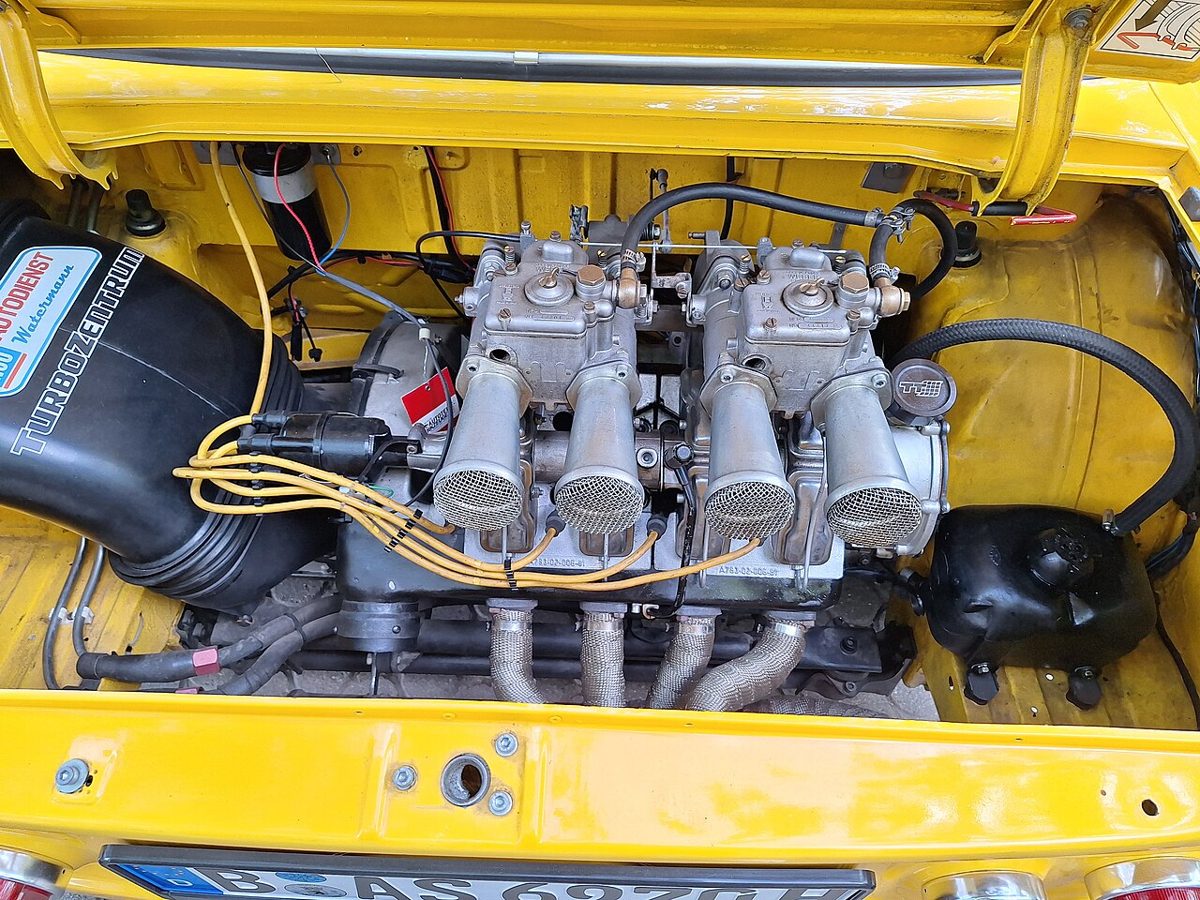
NSU's air-cooled engines deserve their own chapter, because they are why these cars feel the way they do. The Prinz twin is a compact, over-square unit with a cast-iron block and aluminium cylinder head, cooled by a fan driven off the crankshaft and ducted over finned cylinders. There is no radiator, no water pump, no coolant to boil over on a hot day — just air, a fan belt and a thermostat flap. The result is an engine that warms up quickly, tolerates neglect remarkably well, and sounds like nothing else: a hard, metallic, slightly frantic note that rises to a busy howl at the top of the rev range.
Maintenance is refreshingly direct: valve clearances are set with a spanner and a feeler gauge, the fan belt is a five-minute job, and the engine can be dropped out by a determined owner in an afternoon. Parts are still available through German and Dutch specialists. The weak points are well known — tired seals, worn kingpins and swing-axle bearings — which is exactly why this forum exists.
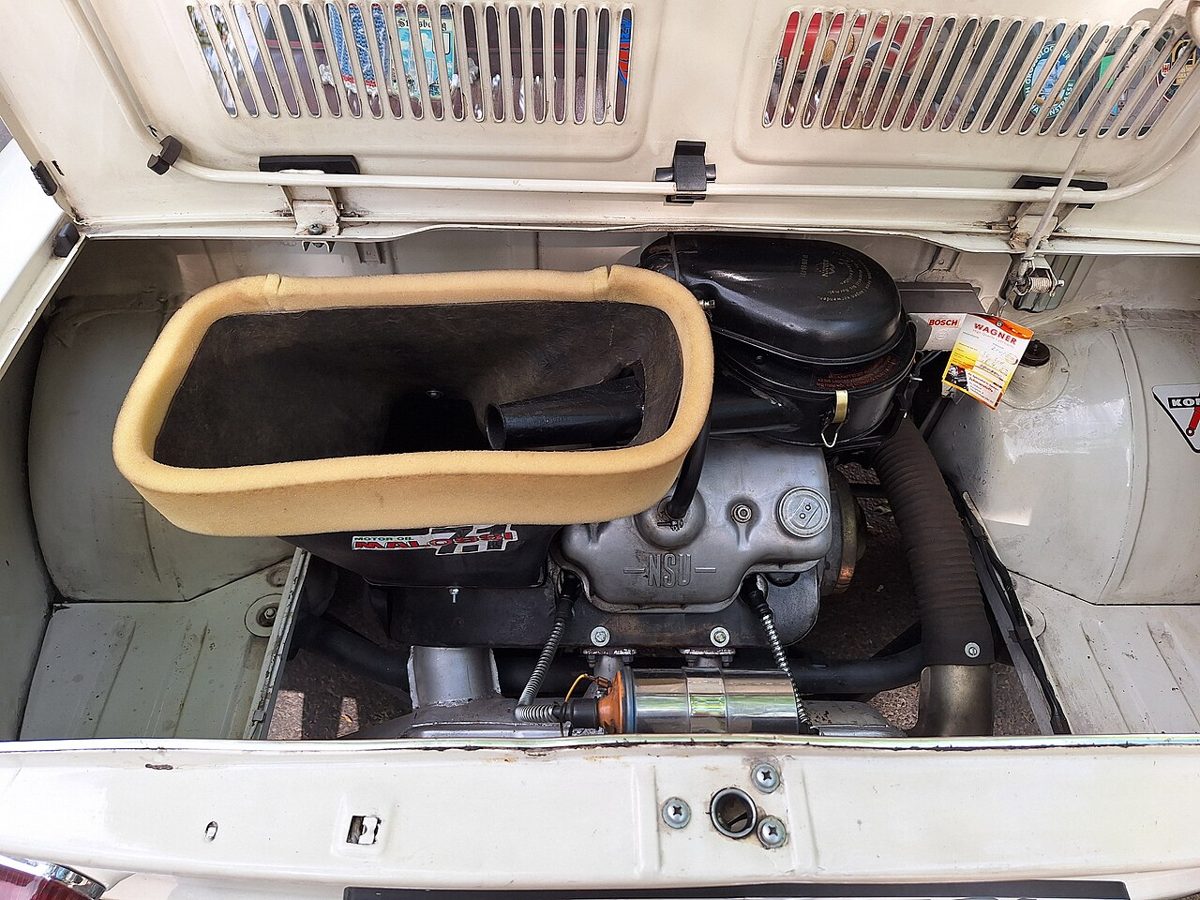
The later four-cylinder engines — the 1,000 cc and 1,200 cc units used in the Prinz 1000 and its derivatives — took the same philosophy and doubled it. Still air-cooled, still in the tail, but with a proper overhead-camshaft head and, in the sporting versions, twin carburettors. These engines are the ones that made NSU's reputation for engineering ambition, and they are the ones that make a TT or TTS such a rewarding car to drive today.
The Sport Prinz: Bertone's Little Coupé
In 1959 NSU did something unexpected: it commissioned a coupé from Bertone. The result, the Sport Prinz, was one of the most elegant small cars of its era — a low, fastback two-plus-two with a wraparound rear window, a long bonnet line and a stance that made the humble Prinz mechanicals underneath seem almost irrelevant. The body was designed by a young Franco Scaglione, and the car was initially built in Italy before production moved to Neckarsulm.
Mechanically the Sport Prinz started with the same 583 cc twin as the saloon, making it more of a stylish cruiser than a sports car. That changed in 1961 with the Sport Prinz 1000, which used the new 996 cc four-cylinder engine and turned the little coupé into a genuine 90 mph machine. Its shape has aged beautifully.
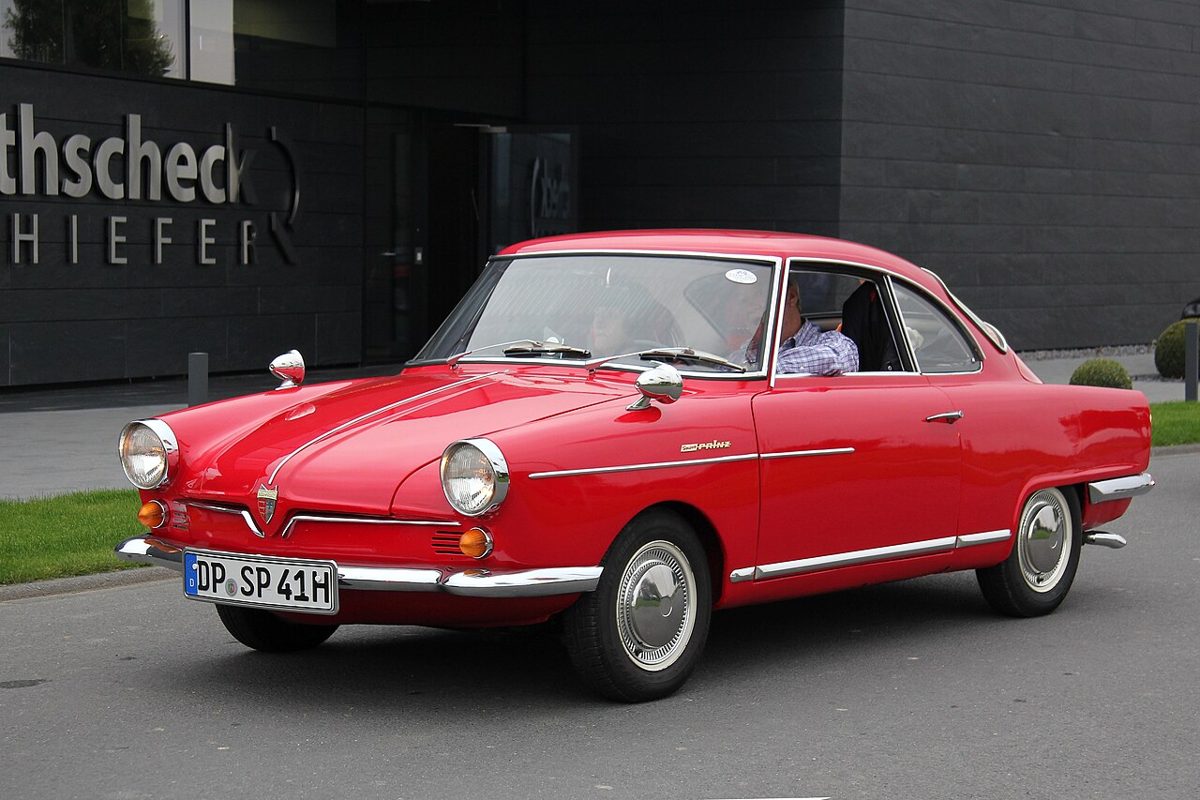
For air-cooled enthusiasts, the Sport Prinz is the sweet spot: all the simplicity of the Prinz package in a body that makes you want to take the long way home. Restoring one is not cheap — the glass and trim are rare — but the mechanicals are shared with the saloons.
The Prinz 1000, TT and TTS: NSU Goes Racing
The early 1960s were NSU's golden years: profitable, winning motorcycle world championships, and pushing into new territory. The Prinz 1000 of 1964 was the first fruit of that ambition — a larger, more modern car with the new 996 cc air-cooled four and a proper four-speed gearbox. It was a good car, but the interesting versions came next.
In 1965 NSU launched the Prinz 1000 TT, a sporting variant with a higher-compression engine, twin carburettors and around 55 hp. The TT was a giant-killer in its class: light, rev-happy and blessed with the kind of chassis balance that made it a favourite on hillclimbs and club circuits. Then came the TTS in 1967, with a 1,200 cc engine, a hotter camshaft and around 70 hp — enough to take the little saloon past 100 mph and into the thick of touring-car racing.
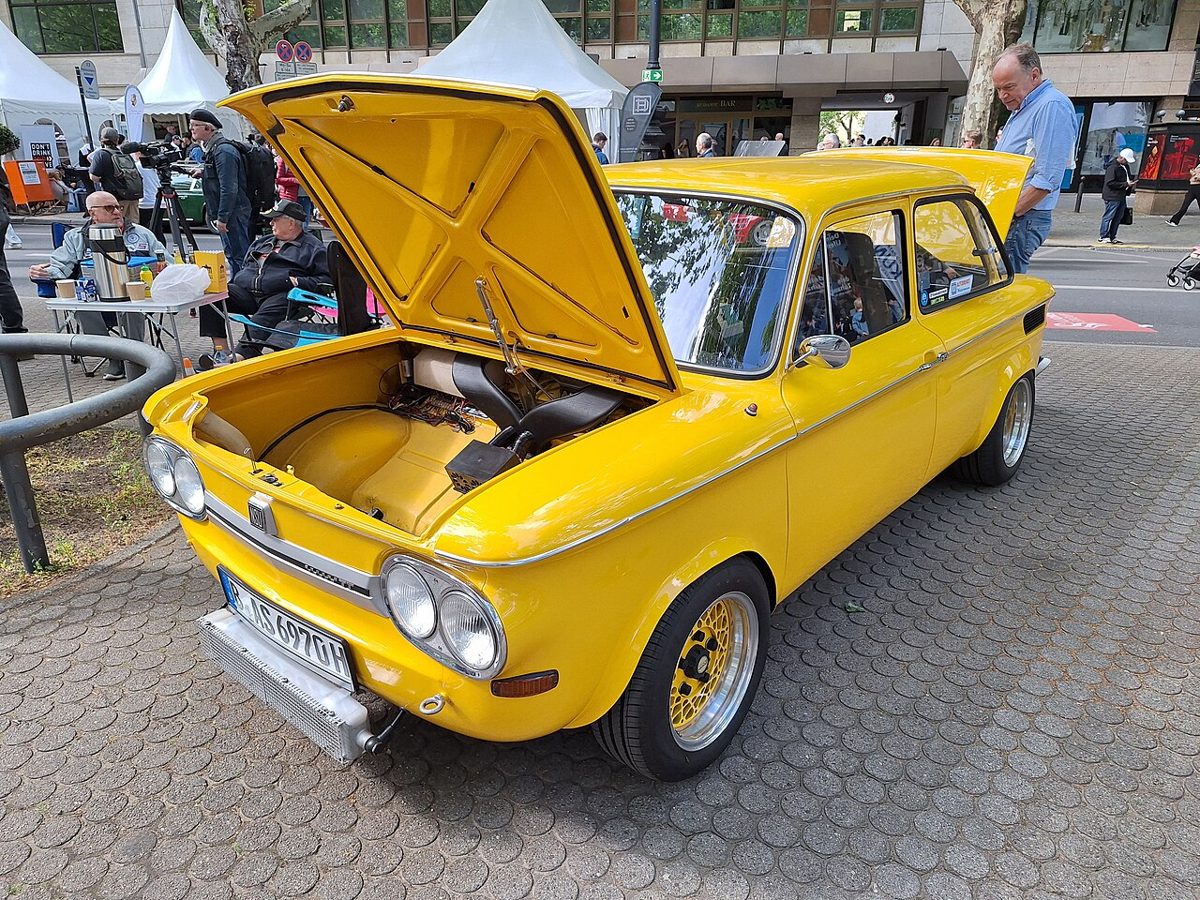
The TT and TTS made NSU's name in motorsport. The company campaigned them in rallying and touring-car racing across Europe, and the TTS became a formidable competitor in the under-1,300 cc classes. Clever engineering, light cars and brave drivers produced some of the most entertaining racing of the decade.
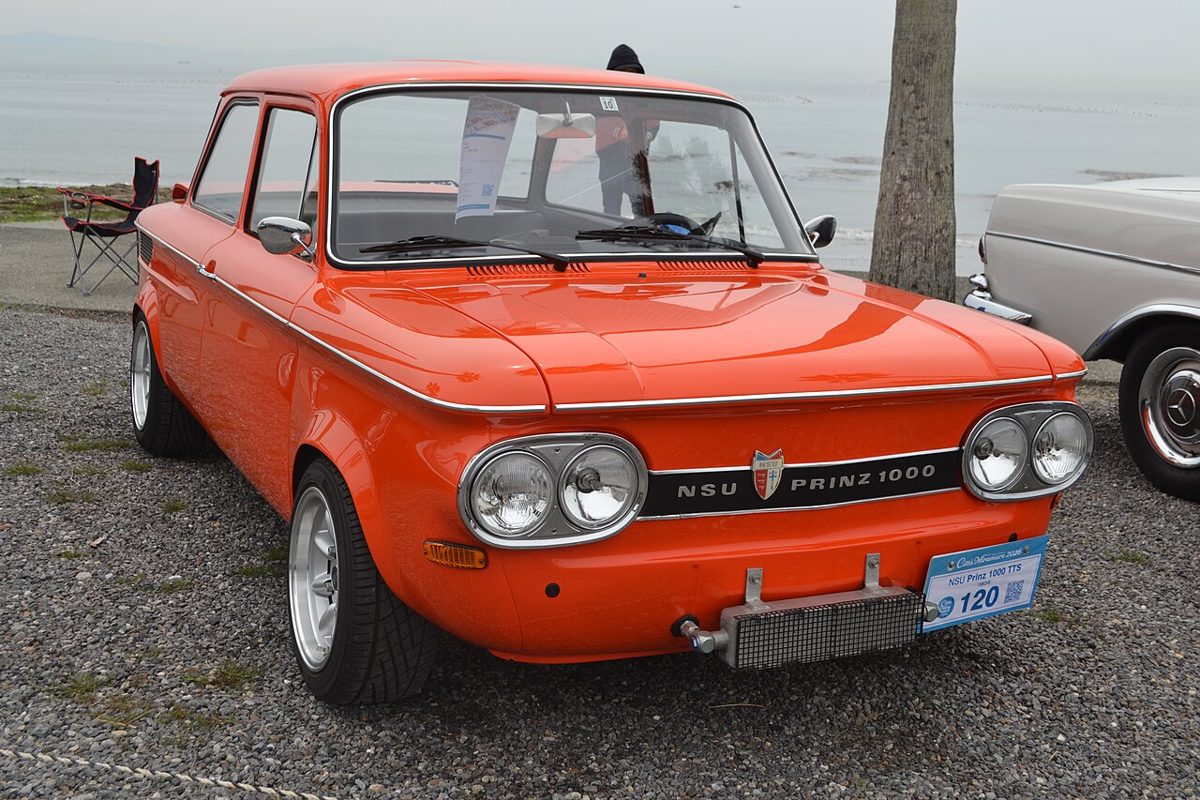
Today the TTS is the enthusiast's choice: all the character of the Prinz family, but with enough power to be genuinely exciting. Values have risen sharply, and good cars are hard to find. Check the sills, the rear quarters, the swing-axle bearings and the twin-carburettor setup.
The Wankel Gamble and the End of Independence
NSU's greatest engineering achievement was also its undoing. In the late 1950s the company acquired the rights to Felix Wankel's rotary engine and poured resources into it. The result was the Wankel Spider of 1964, the world's first production rotary car, and then the Ro 80 of 1967, a futuristic saloon with a twin-rotor Wankel under the bonnet — smooth, quiet and fast, but thirsty, fragile-sealed and ruinously expensive to develop.
The financial strain of the Wankel programme, combined with the cost of developing a new generation of conventional cars, pushed NSU into the arms of Volkswagen. In 1969 VW took control, and the newly formed Audi NSU Auto Union AG absorbed the Neckarsulm works. The Prinz 4 and the 1000/TT/TTS carried on for a few more years, but the independent NSU was gone. The last air-cooled Prinz rolled off the line in 1973, and the factory that had built them turned to Audis.
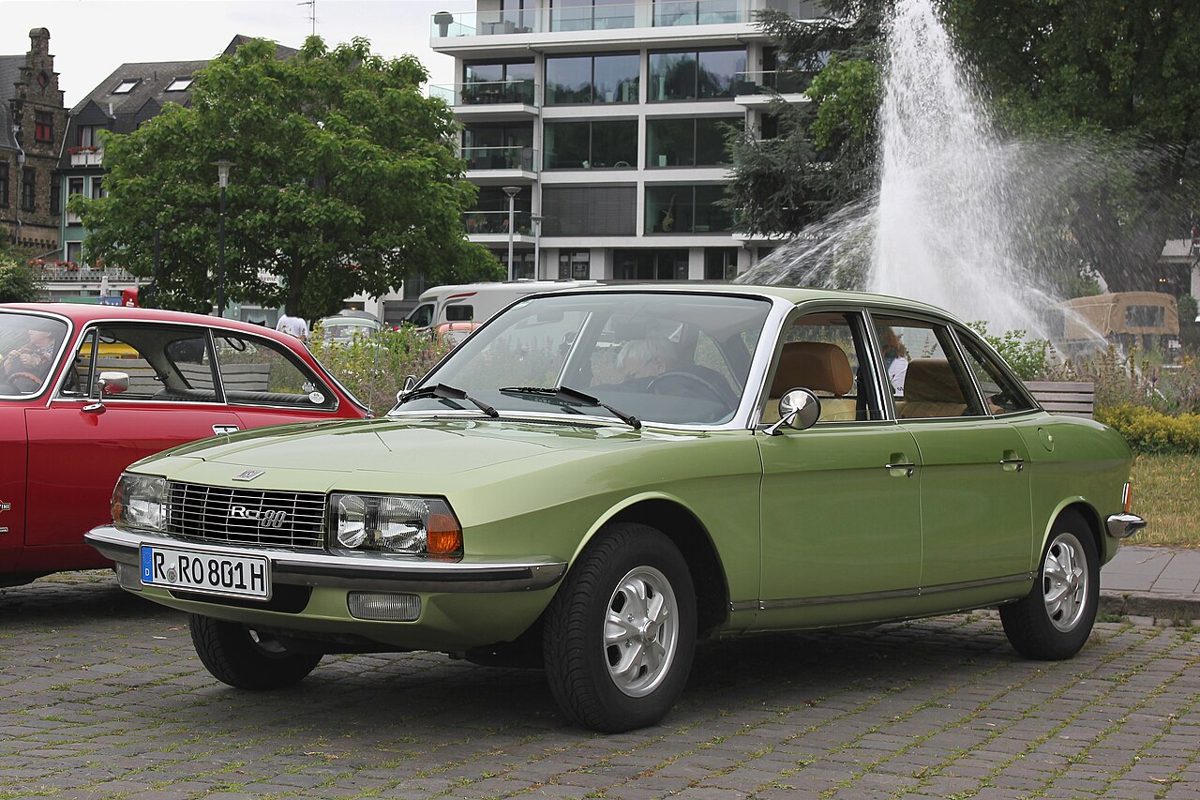
The Ro 80 is not an air-cooled car, but it belongs in this story. It shows what NSU's engineers could do when allowed to dream, and it explains why the company that built the Prinz could not survive on small cars alone.
Why the Air-Cooled NSU Still Matters
It is tempting to treat the Prinz as a curiosity — a bubble car from a vanished company. That would be a mistake. The air-cooled NSUs were genuinely important: they brought rear-engined, air-cooled engineering to a mass market, they proved that a small car could be fun to drive, and they influenced a generation of designers and engineers. The Hillman Imp, the Fiat 850, the Simca 1000 and even the early Honda N360 all owe something to the Prinz's packaging and philosophy.
For those of us who own and drive them, the appeal is simpler. A Prinz is small enough to use, simple enough to maintain, and characterful enough to make every journey an event. The air-cooled engine is at the heart of that: it is a mechanical, honest, slightly eccentric piece of engineering that rewards attention and never pretends to be something it is not. Whether you have a Prinz 4, a Sport Prinz, a TT or a TTS, you are part of a small and friendly community that keeps one of Germany's most interesting engineering stories alive.
So welcome. Park the car, let the engine tick as it cools, and tell us what you have.
Image credits
- COVER: NSU Prinz of 1958, the first of the air-cooled rear-engined Prinz line — Helmuth Ellgaard (uploaded by Holger.Ellgaard), CC BY-SA 3.0, via Wikimedia Commons
- IMG1: NSU Quickly moped of 1958, the two-stroke that put post-war Germany on wheels — Palauenc05, CC BY-SA 4.0, via Wikimedia Commons
- IMG2: NSU Prinz 4 L, the 1961 restyle that carried the air-cooled Prinz into the 1970s — Ermell, CC BY-SA 4.0, via Wikimedia Commons
- IMG3: Engine bay of an NSU Prinz IV: air-cooled two-cylinder in the tail — Fridolin freudenfett, CC BY-SA 4.0, via Wikimedia Commons
- IMG4: NSU Sport Prinz coupé, the Bertone-styled 1959 derivative — Lothar Spurzem, CC BY-SA 3.0, via Wikimedia Commons
- IMG5: NSU Prinz 1000 TT, the 1965 sporting four-cylinder variant — Fridolin freudenfett, CC BY-SA 4.0, via Wikimedia Commons
- IMG6: NSU Prinz 1000 TTS, the 70 hp homologation special — 先従隗始, CC0, via Wikimedia Commons
- IMG7: Air-cooled four-cylinder engine of an NSU Prinz 1000 TT — Fridolin freudenfett, CC BY-SA 4.0, via Wikimedia Commons
- IMG8: NSU Ro 80, the Wankel-engined sedan that marked the end of the independent NSU — Lothar Spurzem, CC BY-SA 3.0, via Wikimedia Commons